
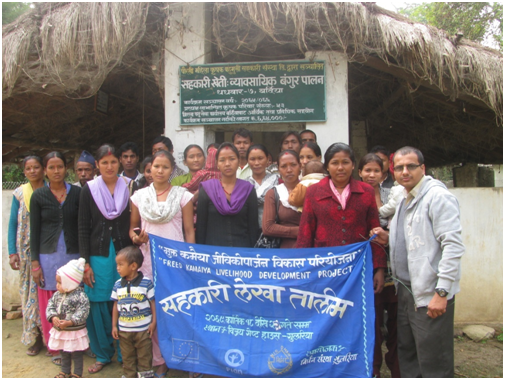
Livelihood Promotion of Freed Kamaiyas in Bardiya District, supported by European Commission/ Plan Nepal (2008-2012)
Freed Kamaiyas Livelihood Development Project
Freed Kamaiya Livelihood Development Project with financial support of European Commission/Plan had been implemented in 28 different VDCs and one municipality of Bardiya district through NIRDHAN (Nirdhan NGO and Nirdhan Utthan Bank Limited) since July 2008 and lasted upto December 2012. Though the project was designed from January 2008, due to different reasons implementation of the project delayed for few months.
Bardiya has almost 400,000 inhabitants with multiple ethnic, linguistic, religious and cultural traits. Among them Tharus are numerically the largest (35{7e30f5cd4daf7698dfdb3ee6e4ab63537cefd70e7c7baecdba6c97439a0f2c6e}) and historically, oldest indigenous people. The high level of poverty in the district is partly explained by the large numbers of freed Kamaiyas in the district. illiterate, unskilled, and without capital, the freed Kamaiya (FK) families have not yet succeed to make effective use of available economic opportunities and are still struggling to build up a new way of life after breaking up the bonded labor relationship with landlords. Presently, Kamaiya’s freedom lacks sustainability because it is not yet built on a sound economic foundation. Children from freed Kamaiya families run a great risk of growing up under far-from-optimal circumstances, unable to realize their full potential.
After the emancipation of Kamaiyas from the former kamaiya system expected resettlement of new villages lacked various socio-economic opportunities as the government didn’t immediately focused for rehabilitation of freed kamaiyas.
Though the Kamaiyas are the oldest residents of the district they always have lived outside of the access to education, health, food and even shelter. This project aimed at addressing such problems of the FKs not only with the help of different activities of livelihoods (Nirdhan NGO’s part) but also with the help of microfinance (NUBL’s part). NUBL forms the Self Reliant Groups (SRG) of females only. FKs communities run predominantly by women and they also often show responsibility towards the upbringing of their children which is one of the best strategies towards women empowerment. NUBL mobilizes communities, facilitate to form Self Reliant Groups (SRGs) and provides financial services whereas Nirdhan NGO provided different types of skill trainings and livelihood supports (non-financial services) to the SRGs. In such a way the project promoted many of the economically promising as well as local resource based enterprises such as vegetable (season and off-season) cultivation, poultry, goat, and other livestock based farming, bee keeping, fishery, and other off-farm activities initially at the scale that simply makes a change in the operational cropping pattern, household income and build collective and individual economic capacities which will help to make it more autonomous and ultimately sustainable.
Objectives of the project were
Overall objective: Agricultural production: Increased & diversified in a sustainable way
► Household income increased with increased access to financial services, market access, production infrastructures, skill development and micro-enterprise development.
► SRGs are able to support sustainable financial and technical support for agricultural and economic development effectively. The objectives will be achieved through:
Ø To have sustained the newly gained freedom of freed kamaiya families.
Ø To have reduced extreme poverty in Nepal.
► To enable children from freed kamaiya families to realize their full potential by ensuring that their rights as children and human beings are being respected.
Expected Results:
- Built social and community institutions·built community physical infrastructure· Transfered livelihood skills· protected livelihood and strengthened resilience.


Leave a Reply
Want to join the discussion?Feel free to contribute!